-CrYNDrPl.png)
Autism Treatment in India for Children
Autism Treatment in India for Children
Autism assessment, child development support and structured Neuro-Ayurveda guidance for families seeking clarity, confidence and a long-term developmental roadmap.

What is Autism Spectrum Disorder?
Key Takeaways
- Understanding Autism Spectrum Disorder (ASD)
- Early Signs of Autism in Children
- Communication, Social & Behavioural Concerns
- Sensory Processing & Developmental Differences
- Importance of Autism Assessment
- Understanding Autism Beyond Visible Symptoms
- Personalized Autism Support & Guidance
- Five-Pillar Neuro-Ayurveda Development System
- Brain Nourishment & Gut Response Support
- Neural Network & Sensory Integration
- Behaviour Guidance & Parent Support
- Manovaidya Assessment & Development Process
- Why Families Choose Manovaidya
- FAQs About Autism & Child Development
Want more content like this?
Join our Autism, ADHD and Child Development newsletter for more care tips from our experts.
Your privacy is important to us.
Autism Treatment, ADHD, Child Development & Mental Health Clinic in India
What is Autism?
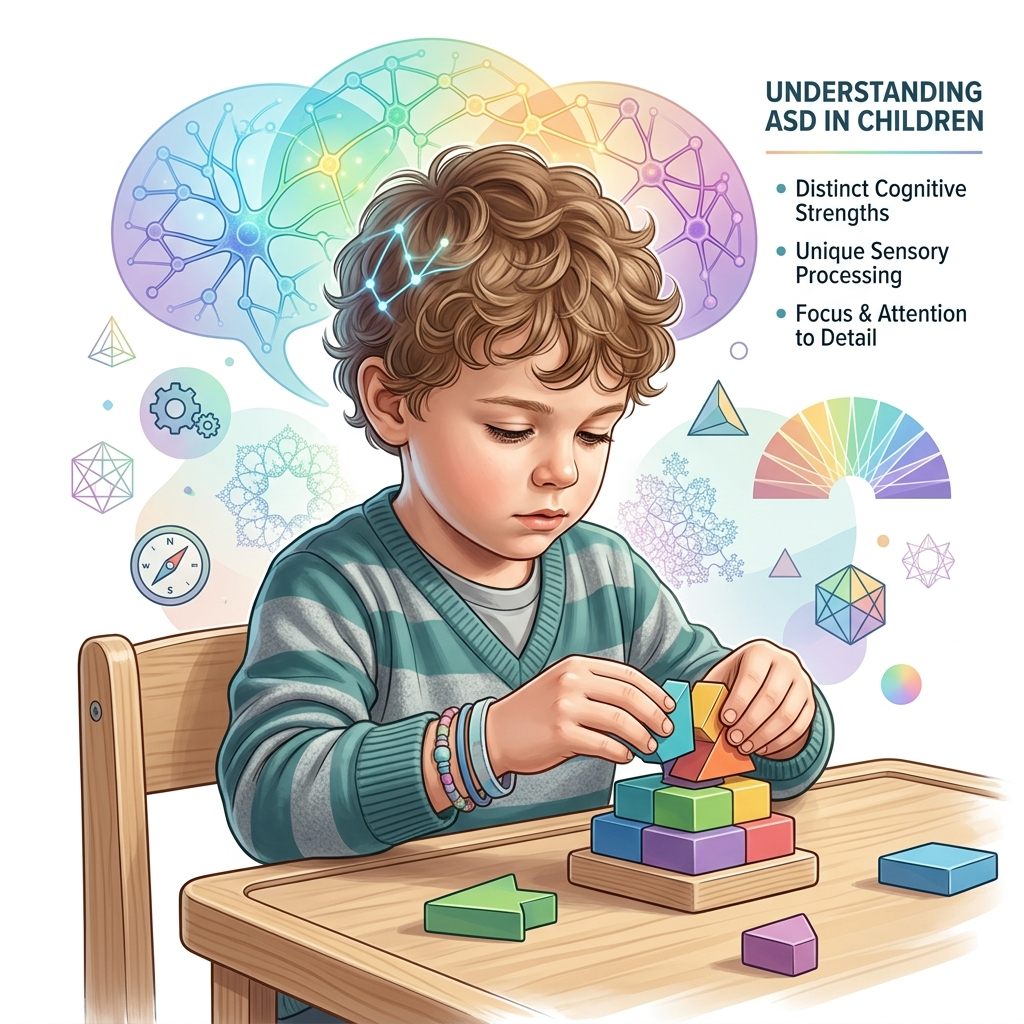
Autism Spectrum Disorder (ASD) is a developmental disorder that affects the way a child learns, communicates, relates to others and processes and reacts to what is around them.
Each child with Autism is different.
Children may experience speech and communication problems, problems with social interaction, attention, behaviour, sensory processing or problems adjusting to changes in routine. Autism can manifest in many different ways and no two children will have the same experience, so it is important that each child's autism journey be understood in their own individual context.
The initial signs that many parents notice are signs of difficulty responding to their name, not looking them in the eye, delays in talking, or repetitive behaviour. Sometimes developmental differences are more apparent when children start interacting with peers or at school.
At Manovaidya we know that it is not just about the symptoms but also knowing what autism is. The development, communication, learning, behaviour, emotional wellbeing, sensory processing and overall growth are all intertwined aspects of a child's development.
This is because our approach is holistic, understanding the child as a whole, and not just on isolated concerns.
Families can become better informed about their child's strengths and developmental difficulties and needs through detailed assessment, developmental understanding and structured guidance.
Dr. Ankush Garg for Autism, ADHD, Child Development and Mental Health offers families from all over India a compassionate, personalized and structured Neuro-Ayurveda Development System.
Dr. Ankush Garg meets with families from all over India, Delhi, Noida, Greater Noida, Ghaziabad and NCR on a regular basis for ADHD, Autism, Child Development and Mental Health support in a structured Neuro-Ayurveda Development System.
Early Signs of Autism
Communication & Speech Concerns
- Delayed speech development
- Limited verbal communication
- Difficulty expressing needs and emotions
- Repeating words or phrases frequently
- Reduced use of gestures such as pointing or waving
- Limited response during conversations
Social Interaction Challenges
- Limited eye contact
- Reduced response when called by name
- Preference for playing alone
- Difficulty initiating social interactions
- Limited interest in sharing experiences with others
- Challenges understanding social cues
Behavioural Differences
- Repetitive movements or actions
- Strong preference for routines
- Difficulty adapting to changes
- Intense focus on specific interests
- Repetitive play patterns
- Emotional reactions when routines are interrupted
Sensory Processing Differences
- Sensitivity to sounds, lights or textures
- Strong reactions to certain foods
- Avoidance of specific sensory experiences
- Seeking sensory stimulation repeatedly
- Difficulty tolerating crowded environments
- Sensory-related emotional responses
Learning & Development Concerns
- Delays in developmental milestones
- Difficulty following instructions
- Challenges with attention and focus
- Differences in learning patterns
- Delays in play skills
- Difficulty with age-appropriate social development
Autism may manifest itself in various ways in each child. Some signs might be obvious in an infant, others more obvious in the toddler stage or early childhood.
If a child is identified early, parents can get the information they need to understand their child's needs and receive appropriate guidance at an opportune time.
Signs that may be observed include:
Delayed speech development
Limited verbal communication
Difficulty expressing needs and emotions
Repeating words or phrases frequently
Reduced use of gestures such as pointing or waving
Limited response during conversations
Social Interaction Challenges
Limited eye contact
Reduced response when called by name
Preference for playing alone
Difficulty initiating social interactions
Limited interest in sharing experiences with others
Challenges understanding social cues
Behavioural Differences
Repetitive movements or actions
Strong preference for routines
Difficulty adapting to changes
Intense focus on specific interests
Repetitive play patterns
Emotional reactions when routines are interrupted
Sensory Processing Differences
Sensitivity to sounds, lights or textures
Strong reactions to certain foods
Avoidance of specific sensory experiences
Seeking sensory stimulation repeatedly
Difficulty tolerating crowded environments
Sensory-related emotional responses
Learning & Development Concerns
Delays in developmental milestones
Difficulty following instructions
Challenges with attention and focus
Differences in learning patterns
Delays in play skills
Difficulty with age-appropriate social development
Please keep in mind that by having one or two signs alone does not mean autism. Developmental issues vary from child to child and developmental issues always need to be viewed within the context of the child's developmental and growth history.
A thorough evaluation assists in gaining a better understanding of developmental strengths, challenges and needs.
Autism Treatment in India: Understanding Autism Beyond Symptoms
One of the most common concerns parents face is focusing only on visible symptoms.
Parents often ask:
How can my child speak better?
Why does my child avoid eye contact?
Why does my child become upset so easily?
Why is learning difficult?
These questions are key, but sometimes the symptoms are not enough to understand a child's developmental needs.
We, at Manovaidya, would like to emphasize that we encourage families to think beyond the behaviour itself and to consider the developmental context.
Communication, learning, behaviour, attention, sensory processing, emotional regulation and social interaction are frequently interrelated.
For instance, communication problems can impact the behavior. Social participation can be impacted by sensory sensitivities. Attention challenges may impact learning and skill development. Emotional regulation challenges can impact on everyday life and relationships with others in the family.
This is a webbed knowledge which is the basis of the Neuro-Ayurveda Development System that is followed at Manovaidya.
The developmental concerns are not seen as individual concerns but rather an understanding of the factors that may impact overall developmental and wellbeing.
Each child has their own strengths, abilities and potentials. Knowing more about the situation, having a structured plan and personalized assistance can often allow families to chart a course that can move their child forward in a constructive and sustainable way.
The purpose is not just to address individual symptoms, but to enable effective communication, learning, behaviour, confidence, participation, emotional wellbeing and development in a holistic way throughout the developmental process.
Autism Assessment at Manovaidya
- Communication abilities
- Social interaction skills
- Attention and focus
- Learning patterns
- Behavioural concerns
- Sensory processing
- Emotional regulation
- Daily functioning
- Developmental strengths
- Areas requiring support
Each child is special and each child's developmental path is unique.
A big error families often make is comparing their child to another child and/or using only information found online as the basis for understanding autism. These online resources are effective for creating awareness, but cannot substitute for a developmental assessment using a structured format focusing on the child as a person.
The autism assessment at Manovaidya is based on the understanding of the total developmental pattern, not just one symptom.
The assessment process aims to enable families to have clarity around:
- Communication abilities
- Social interaction skills
- Attention and focus
- Learning patterns
- Sensory processing
- Emotional regulation
- Daily functioning
- Developmental strengths
- Areas requiring support
We aim not only to recognise the problems but to gain an insight into the child's particular developmental profile and to provide a purposeful trajectory for future development and support
.One of the most crucial initial steps in the family journey towards receiving Autism Treatment in India is the comprehensive Autism Assessment, which helps define developmental needs and future planning for support.
What Does the Assessment Process Include?
- Communication abilities
- Social interaction skills
- Attention and focus
- Learning patterns
- Behavioural concerns
- Sensory processing
- Emotional regulation
- Daily functioning
- Developmental strengths
- Areas requiring support
Detailed Parent Discussion
Parents are the first and ultimate source of information about their child.
This is why the evaluation process starts with a thorough developmental history, as well as the concerns and day-to-day functioning of the child.
We discuss:
Pregnancy and birth history
Early developmental milestones
Speech and communication development
Behavioural observations
Social interaction patterns
Learning abilities
Sensory concerns
Sleep and daily routines
Food preferences and eating habits
Family observations and challenges
This information is useful to help outline the child's developmental trajectory.
Developmental Understanding
Each child matures at his own rate.
The assessment process will identify:
Existing strengths
Current developmental challenges
Areas requiring additional support
Learning readiness
Communication abilities
Behavioural patterns
Sensory processing differences
This knowledge enables families to get from uncertainty to clarity.
Individualized Guidance
Families are provided with developmentally appropriate information about what might come next.
This may include:
Developmental support planning
Behaviour guidance strategies
Communication support recommendations
Sensory support suggestions
Lifestyle and routine recommendations
Progress monitoring approaches
The goal is to offer a straightforward and actionable plan for families.
The Neuro-Ayurveda Development System
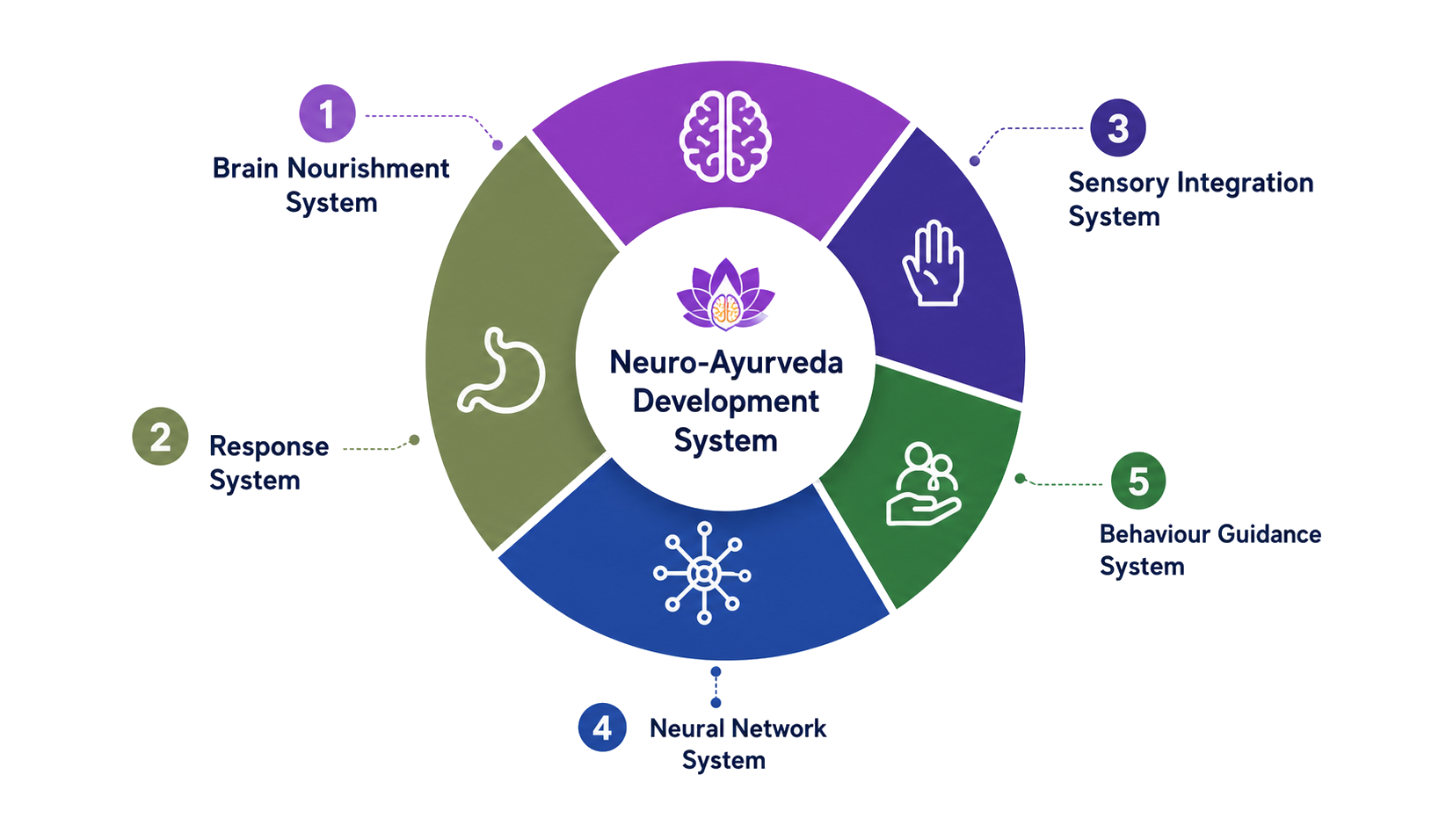
Developmental and Behavioural issues are comprehended through the structured Neuro-Ayurveda Development System by Dr. Ankush Garg at Manovaidya.
This is designed to support families to better understand the interrelated factors that could affect a child's communication, learning, behaviour, attention, sensory processing and development.
The Neuro-Ayurveda Development System does not aim at just the symptom alone, but rather aims to understand the whole child, five connected together, through their different developmental needs.
Pillar 1: Brain Nourishment System:
Brain development impacts learning, attention, memory and communication and social interaction.
The Brain Nourishment System is designed to help nourish the fundamental functions that support healthy cognitive and developmental processes.
The objective of this pillar is to be aware of elements that could have an impact on:
- Attention
- Learning readiness
- Communication development
- Cognitive functioning
- Memory
- Emotional regulation
The objective is to build a greater base for development and growth.
Pillar 2: Gut Response System
Digestion and wellbeing have always been linked in traditional and modern health care.
Children with developmental issues often have:
- Picky eating
- Digestive discomfort
- Food sensitivities
- Irregular bowel habits
- Appetite concerns
Gut Response System is about understanding the possible connection between digestive wellness and function and development.
Pillar 3: Neural Network System
Development takes place through inter-connections in the brain.
The Neural Network System is dedicated to supporting developmental readiness, including an understanding of ways that learning, attention, communication and behaviour may be shaped by underlying developmental pathways.
Common areas for exploration and play may involve:
- Learning readiness
- Response patterns
- Communication development
- Attention
- Social engagement
Pillar 4: Sensory Integration System
Most children with autism have sensory issues.
Some children may be overstimulated by sounds, lights, textures or masses of people, and others may be actively searching for sensory stimulation.
The Sensory Integration System is about how to make sense of:
- Sensory sensitivities
- Sensory preferences
- Sensory regulation
- Daily functioning challenges
- Environmental influences
When families understand the sensory needs, it can provide a better foundation for being able to contribute to their child's comfort and participation.
Pillar 5: Behaviour Guidance System:
Behaviour can be a way of communicating.
Children might communicate their needs, frustrations, discomforts or feelings in terms of behaviour.
The Behaviour Guidance System is based on helping families to understand:
Why behaviours occur
Possible developmental influences
Environmental triggers
Emotional regulation challenges
Supportive behaviour guidance approaches
The aim is to shift from reactive responses to behaviours to understanding what factors are driving behaviours.
How We Work at Manovaidya
Each child is different and support starts with a whole child approach and not just a diagnosis.
We begin with a comprehensive evaluation to gain insights into developmental background, communication skills, behavioural areas, learning needs and attention profile, sensory experiences and family concerns. This knowledge enables families to be guided individually and to be given a developmental plan from the outset.
Manovaidya takes a holistic understanding of the factors that can affect communication, attention, behaviour, learning, emotional wellbeing and overall development, as opposed to a one-size-fits-all approach, and uses the Neuro-Ayurveda Development System to help families better understand these factors.
Support includes assessment, parent guidance, developmental planning, tracking progress and long-term family support, helping parents to move forward with more clarity, confidence and direction.
Each child is an individual. That's why support at Manovaidya starts with an in-depth assessment and understanding of developmental needs and tailor-made guidance-no one-size-fits-all solutions here!
How We Support Children with Autism
- Understanding the child as an individual
- Identifying developmental strengths
- Recognizing areas requiring support
- Providing structured parent guidance
- Creating individualized support plans
- Monitoring developmental progress
- Supporting long-term growth and wellbeing
No two children are alike, which means that at Manovaidya their support is individual.
All children are different and have different strengths and challenges, interests and developmental needs.
Our approach focuses on:
Understanding the child as an individual
Identifying developmental strengths
Recognizing areas requiring support
Providing structured parent guidance
Creating individualized support plans
Monitoring developmental progress
Supporting long-term growth and wellbeing
The short term is not the only focus, and the structured and family centred approach is used to ensure developmental progress is sustainable.
Many families approach Manovaidya while looking for Autism Treatment in India as they are seeking a personalized approach focused on communication, behaviour, learning, sensory integration and overall child development.
Parent Guidance & Family Support
Autism impacts not just the child.
It also has an impact on the parents, siblings and family system.
Many parents experience:
Confusion
Information overload
Decision fatigue
Fear about the future
Emotional exhaustion
Parent guidance is seen as an integral part of the developmental journey at Manovaidya.
Families receive support in understanding:
Their child's strengths
Developmental challenges
Communication needs
Behavioural patterns
Daily support strategies
Long-term developmental planning
Increased understanding and confidence can lead to more effective support within the family to the child's growth and wellbeing.
Our goal is to help families move from uncertainty and overwhelm toward clarity, confidence and meaningful action.
Why Families choose Manovaidya?
Personalized Developmental Understanding
Assessment and guidance are tailored to the child's individual strengths, challenges and developmental needs.
Structured Neuro-Ayurveda Development System
The five-pillar framework helps families understand factors that may influence communication, attention, learning and behaviour.
Family-Centred Approach
Parents are not expected to navigate the journey alone. Guidance helps families gain clarity and confidence.
Long-Term Development Focus
The emphasis is not only on short-term symptom management but also on meaningful developmental growth over time.
Personalized Guidance & Progress Tracking
Families receive structured recommendations and support to monitor developmental progress in an organized manner.
Support Across Developmental Needs
The approach may support communication, behaviour, learning, attention, sensory processing and social development.
Selecting the right help system for an autistic child can be daunting.
Sometimes parents are given conflicting advice from various professionals. Others are assigned to concentrate on just speech. The others are encouraged to work on behaviour, sensory integration, special education or routines. As families grow and develop, they often try different strategies and continue to seek more understanding of their child's development over time.
The objective at Manovaidya is to make families aware of the bigger picture.
We do not only look at individual symptoms, but we bring together all aspects of communication, learning, behaviour, sensory processing, emotional wellbeing and development of the child through a structured Neuro-Ayurveda Development System.
Families choose Manovaidya because of:
Personalized Developmental Understanding
All children are unique. Assessment and guidance are differentiated for each child's strengths, challenges and developmental needs.
Structured Neuro-Ayurveda Development System
The five-pillars framework supports families to gain a better understanding of the contributing factors to development/communication, attention, learning and behaviour.
Family-Centred Approach
Parents are expected to have a guide to help them on the journey. Advice is given to assist families to become clear and confident about supporting their child.
Long-Term Development Focus
It is not just about achieving the immediate symptom management, but also about ensuring ongoing meaningful developmental growth.
Personalized Guidance & Progress Tracking
Families are given clear recommendations and support which can enable them to check the progress of development in a more systematic way.
Support Across Different Developmental Needs
The way works with children who have communication, behavioural, learning, attention, sensory issues and social development problems.
The reason why Indian families choose Manovaidya is because they are seeking structured ADHD Treatment support, personalized guidance and a long-term developmental roadmap for their child.
The families from India, Delhi, Noida, Greater Noida, Ghaziabad and other parts of the NCR region opt for Manovaidya, because they are in search of a structured ADHD Treatment support, personalized guidance and a long term developmental roadmap for their child.
About Dr. Ankush Garg
Autism, ADHD, Child Development & Mental Health Specialist in India
Dr. Ankush Garg is the Founder of Manovaidya and Creator of the Neuro-Ayurveda Development System, a structured framework developed to support developmental, behavioural and mental wellness concerns through a comprehensive and personalized approach.
His work focuses on Autism Spectrum Disorder (ASD), ADHD, Child Development, Behavioural Challenges, Speech & Communication Concerns, Teen Mental Health, Adult Mental Health, Women's Emotional Wellbeing, Stress-Related Concerns and Senior Mental Health Support.
Through Manovaidya, Dr. Ankush Garg combines traditional Ayurvedic understanding with modern insights into brain development, behaviour, emotional wellbeing and cognitive health. His approach emphasizes root-cause understanding, personalized guidance, family-centred support and long-term wellness planning.
Through detailed assessment, individualized recommendations and structured follow-up, he helps children, adults and families better understand their concerns and move forward with greater clarity, confidence and direction.
Families from across India connect with Dr. Ankush Garg for Autism, ADHD, Child Development and Mental Health support through a compassionate, personalized and structured Neuro-Ayurveda approach.
Frequently Asked Questions About Autism
Autism Spectrum Disorder (ASD) is a condition affecting the developmental functioning of the brain that could affect communication, social interaction, behaviour, learning, and sensory processing. Each child with autism is an individual and the developmental needs of children may differ in many ways. Some children may have delays in speaking, or problems with attention/sensory sensitivities or social interaction. Autism is seen at Manovaidya in the context of the whole child; the child's communication, behaviour, learning, emotional development and wellbeing.
Book a Consultation
If you are looking for Autism Treatment in India, Autism Assessment, Child Development Support or guidance regarding communication, behaviour, learning and developmental concerns, you can schedule a consultation with Dr. Ankush Garg and the Manovaidya team.
Through a structured assessment and personalized guidance process, families can gain a clearer understanding of their child's developmental needs and explore appropriate next steps for long-term growth, learning and wellbeing.
Take the First Step
- Autism Assessment
- Personalized Development Guidance
- Parent Support & Family Guidance
- Neuro-Ayurveda Development System
- Structured Progress Planning
Manovaidya Clinic
Noida, Uttar Pradesh, India
Book a Consultation
Take the First Step Today
If you are looking for Autism Treatment in India, Autism Assessment, Child Development Support or guidance regarding communication, behaviour, learning and developmental concerns, you can schedule a consultation with Dr. Ankush Garg and the Manovaidya team.
Through a structured assessment and personalized guidance process, families can gain a clearer understanding of their child's developmental needs and explore appropriate next steps for long-term growth, learning and wellbeing.
- Autism Assessment
- Personalized Development Guidance
- Parent Support & Family Guidance
- Neuro-Ayurveda Development System
- Structured Progress Planning
Manovaidya Clinic
Noida, Uttar Pradesh, India